Open USD Launches With Backing From Visa, Mastercard, Google, and 140+ Companies

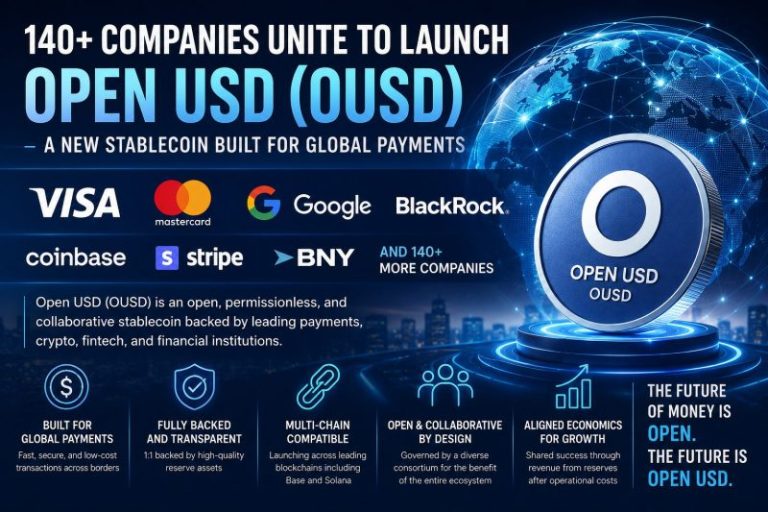
A coalition of more than 140 companies has unveiled Open USD (OUSD), a new U.S. dollar-backed stablecoin designed to accelerate global digital payments and expand enterprise adoption of blockchain-based financial infrastructure. The initiative, led by Open Standard, brings together major payment networks, financial institutions, technology companies, and cryptocurrency firms, including Visa, Mastercard, Google, BlackRock, Coinbase, Stripe, and BNY.
The consortium plans to launch OUSD later this year across multiple blockchain networks, including Base and Solana. Unlike many existing stablecoins, OUSD is structured as a shared industry initiative rather than a product controlled by a single issuer. Participating companies will be able to mint and redeem the stablecoin without fees or volume limits, while sharing reserve-generated earnings after operational costs.
A New Model for Stablecoin Adoption
Open Standard says the project aims to solve long-standing barriers that have limited enterprise stablecoin adoption.
Key features include:
- Zero-fee minting and redemption for participating businesses.
- Shared governance across consortium members instead of centralized control.
- Revenue sharing from reserve assets among ecosystem partners.
- Support for multiple blockchain networks to improve interoperability.
Founding CEO Zach Abrams said businesses need an open, low-cost, and scalable infrastructure to bring stablecoins into mainstream financial services. The consortium believes aligning economic incentives across participants will encourage broader adoption than traditional issuer-controlled models.
Growing Competition in the Stablecoin Market
The announcement comes as stablecoins gain momentum following the introduction of U.S. federal regulations under the GENIUS Act. While stablecoins have historically been used primarily for cryptocurrency trading, payment companies increasingly view them as infrastructure for cross-border transfers, settlement, and commercial payments.
OUSD will enter a market currently dominated by Tether’s USDT and Circle’s USDC. The new consortium’s scale immediately positions it as a significant challenger, particularly because many of its members already operate global payment networks or financial platforms. Investors reacted quickly to the announcement, with shares of Circle declining as markets assessed the potential competitive impact.
If Open USD succeeds in attracting enterprise payment flows, it could reshape how businesses issue, transfer, and settle digital dollars while expanding the role of stablecoins in everyday financial transactions.