
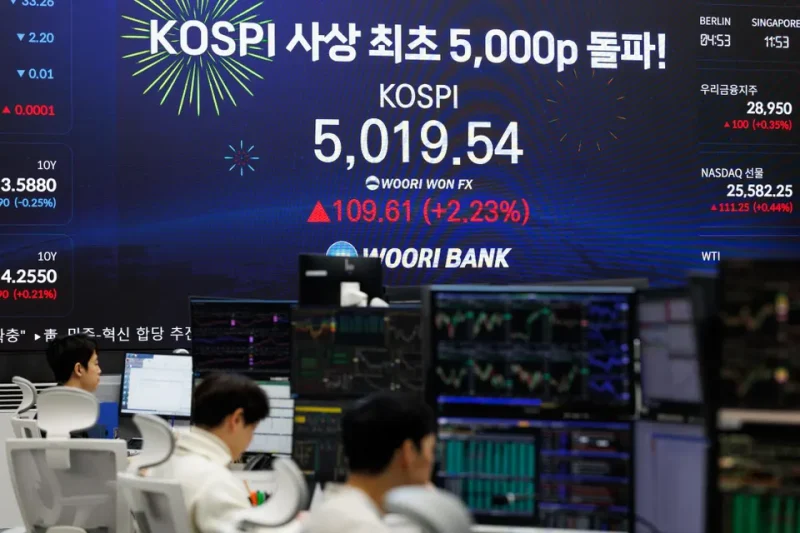
South Korea’s stock market faced a dramatic selloff this week as rising geopolitical tensions shook global financial markets. The benchmark Kospi index recorded its steepest two day fall since the 2008 financial crisis. Investors rushed to reduce risk as energy prices surged and fears of a wider Middle East conflict grew.
Trading sessions on March 3 and March 4, 2026 triggered panic across Asian markets. The Kospi dropped sharply after reopening from a public holiday. At one point, the index slid about 11 percent before trimming some losses. Authorities even activated circuit breakers to slow the selloff and calm investor sentiment.
Technology Giants Lead the Market Decline
Major semiconductor companies suffered the biggest losses during the crash. South Korea’s technology sector holds a large weight in the Kospi index, so declines in chipmakers quickly pulled the broader market lower.
Key stocks that dropped significantly include:
- Samsung Electronics fell more than 10 percent during the selloff
- SK Hynix declined between 8 and 12 percent across the two sessions
- Semiconductor stocks faced pressure despite strong AI driven demand earlier this year
These companies had helped push South Korea’s stock market to strong gains earlier in 2026. However, the sudden shift in global risk sentiment erased much of that momentum.
Energy Prices and Geopolitics Shake Investor Confidence
The selloff followed a sharp spike in global energy prices. Brent crude oil jumped roughly 14 percent in just two days. At the same time, European natural gas prices surged as traders worried about supply disruptions.
South Korea remains one of the world’s largest importers of oil and liquefied natural gas. Therefore, rising energy costs quickly raise concerns about inflation and economic growth. Investors also worry about supply routes such as the Strait of Hormuz, which remain critical for global energy shipments.
Regional Markets Feel the Pressure
The shockwaves spread across Asia as well. Japan’s Nikkei, along with markets in Hong Kong, Shanghai, and Australia, also recorded losses.
Investors now watch two key factors closely:
- Whether Middle East tensions escalate further
- If global energy prices stabilize in the coming weeks
Earlier in 2026, the Kospi ranked among the world’s best performing stock markets thanks to strong semiconductor demand tied to artificial intelligence. However, the current volatility shows how quickly geopolitical risks can shift global market sentiment.
