
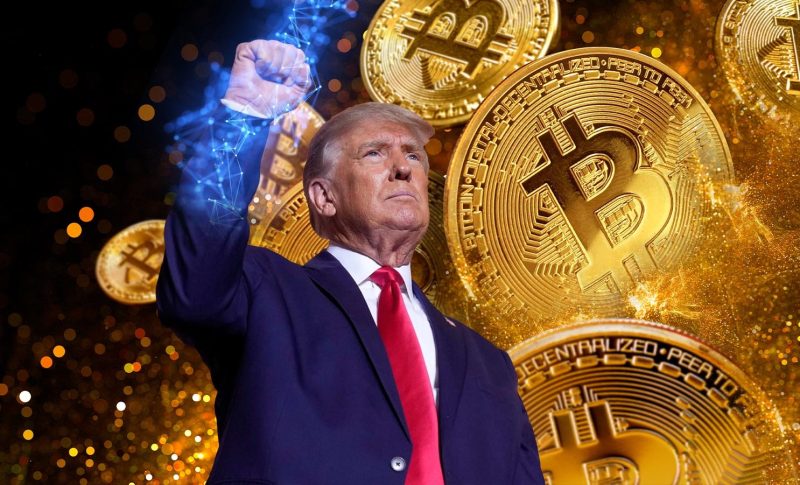
Donald Trump, former president and 2024 Republican presidential candidate, is making bold claims about cryptocurrency, promising to revamp the industry if he returns to office. With a track record of unfulfilled pledges, however, some question whether Trump can deliver on these ambitious promises.
In his latest pitch to crypto enthusiasts, Trump is positioning himself as a champion of digital assets, pledging to end regulatory crackdowns, promote Bitcoin mining, and even suggesting that crypto could help solve the national debt. But can he make these promises a reality?
Trump’s Vision: A Crypto-Friendly America
In early July, the Republican Party’s proposed policy agenda featured a commitment to end the current administration’s restrictions on crypto. The draft also promised to oppose the creation of a Central Bank Digital Currency (CBDC), protect Bitcoin mining rights, and secure Americans’ ability to self-custody digital assets.
At the 2024 Bitcoin Conference in Nashville, Trump stated that he would halt President Biden’s “anti-crypto crusade” immediately upon taking office. His promise to “end it” struck a chord with the crypto community, raising expectations for a more favorable regulatory environment.
The Feasibility of “Bitcoin Made in the USA”
In June, Trump used Truth Social to outline a goal of producing Bitcoin domestically, claiming it would enhance U.S. energy independence. Trump’s ambition to boost American Bitcoin mining aligns with his broader energy policy, yet mining is inherently decentralized. Today, around 90% of Bitcoin’s fixed 21 million supply has already been mined, leaving limited new supply to control.
Ben Gagnon, CEO of crypto mining company Bitfarms, believes America could indeed become a leading Bitcoin mining hub. According to Gagnon, reducing bureaucratic obstacles and increasing energy infrastructure investment could make the U.S. the most competitive Bitcoin mining country. However, he also noted that fully centralizing mining would violate Bitcoin’s core principles of decentralization.
Trump’s goal to make the U.S. the primary source of remaining Bitcoin, though appealing to some, conflicts with Bitcoin’s foundational ideals established by creator Satoshi Nakamoto. Bitcoin mining on a national scale might boost U.S. production, but monopolizing it within one country would undercut the global, decentralized nature of the blockchain network.
Can Crypto Address the $35 Trillion National Debt?
With the U.S. national debt now over $35 trillion, Trump has suggested that cryptocurrency might offer a solution. At an event promoting his NFT collection, Trump touted crypto’s potential, hinting it could somehow contribute to reducing the staggering debt.
Experts in the field remain cautious about this assertion. Ric Edelman, founder of the Digital Assets Council of Financial Professionals, agrees that crypto has long-term potential to support economic growth but cautions that it alone cannot eliminate the debt. Crypto may contribute in specific sectors, such as streamlining financial transactions or enhancing tax efficiency, but paying off the national debt entirely through crypto is likely beyond reach.
Key Challenges Ahead for Trump’s Crypto Promises
Trump’s crypto promises are ambitious, yet several obstacles stand in the way. For his vision to succeed, he would need bipartisan support to reshape regulatory policies around digital assets, an area historically met with mixed responses from lawmakers. Additionally, establishing America as a Bitcoin mining powerhouse would require extensive investment in energy and infrastructure, potentially clashing with environmental policies that aim to curb carbon emissions.
While Trump’s crypto-friendly stance may resonate with certain voters, fulfilling these promises requires overcoming both political and practical hurdles. Whether Trump can turn his crypto vision into a reality will depend largely on his ability to navigate these complex issues.
